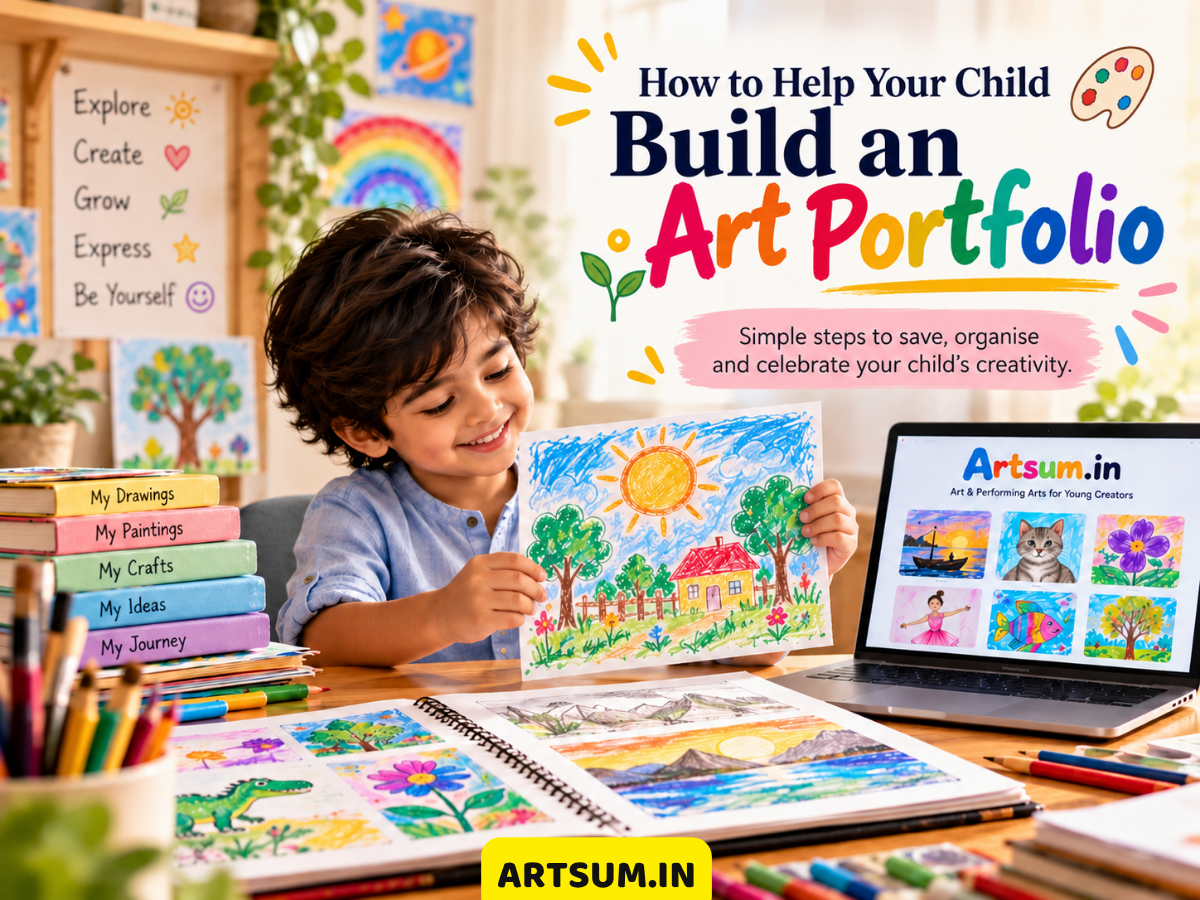
Every child draws. Few parents think about what happens to those drawings afterward. They end up on the fridge, then in a drawer, and eventually in a box nobody opens.
An art portfolio changes that. It doesn’t have to be a fancy folder for art school applications. At its simplest, it is a collection of your child’s best work, kept in one place, showing how their creativity grows over time. Starting before age 12 gives your child a real head start, and it makes them feel proud of what they make.
Why Start a Portfolio So Early?
It builds confidence. When children see their work collected and valued, they start to see themselves as artists.
It shows progress. A scribble at age 4 and a detailed landscape at age 9 tell a story that no single drawing can.
It opens doors later. Art schools, scholarships, competitions and school programs often ask for a body of work. A child who has been collecting since age 6 will never be scrambling at 16.
It keeps memories safe. Paper fades, tears and gets lost. A digital copy stays.
Step 1: Save More Than You Think You Should
Don’t wait for the “perfect” drawing. In the early years, keep anything that shows effort, a new idea or a new technique. You can always select the best pieces later.
Quick tip: write the date and your child’s age on the back of every piece. It takes five seconds and becomes priceless later.
Step 2: Let Your Child Choose Favorites
Once every few months, sit down together and ask:
Which one are you proudest of?
Which one was the most fun to make?
Which one took the most effort?
Letting your child pick teaches them to look at their own work thoughtfully. It also keeps the portfolio theirs, not yours.
Step 3: Photograph or Scan Everything
Good photos are enough. Follow these simple rules:
Use daylight near a window, not a flash.
Place the artwork flat on a plain surface.
Take the photo straight from above so the edges don’t look slanted.
Keep fingers and shadows out of the frame.
Sort photos into folders by year, or by theme such as animals, family, festivals and imagination.
Step 4: Include Variety
A strong portfolio isn’t only pencil sketches. Encourage different kinds of work:
Drawings and colorings
Paintings and watercolors
Crafts and paper art
Rangoli and festival art
Digital art, if your child enjoys it
Variety shows range, and it helps your child discover what they love most.
Step 5: Add a Short Note to Each Piece
Ask your child to say one or two lines about each artwork. What is it? What inspired it? What did they enjoy while making it? These notes turn a gallery of pictures into a personal story.
Step 6: Share the Work with a Real Audience
Art feels different when someone else sees it. Showing work to family, teachers and other young artists motivates children to keep creating.
Artsum.in was built for exactly this. It is a free platform where students aged 3 to 18 can upload their artwork and performing arts, so their creations have a home online and an audience beyond the living room.
Step 7: Review and Refresh Every Year
Once a year, perhaps on your child’s birthday or at the start of a new school year, review the portfolio together. Add new pieces and retire older ones if needed. Celebrate how far they’ve come.
Common Mistakes to Avoid
Over-correcting. A portfolio is not a test. Let your child’s style be their own.
Keeping only “perfect” pieces. Imperfect work shows real growth.
Comparing with other children. Every child’s journey is different.
Forgetting to back up. Store digital copies in at least two places.
Final Thoughts
You don’t need expensive supplies or formal training to start a portfolio. You just need to notice, save and celebrate your child’s creativity. Start with the drawing on your table today. Years from now, both of you will be glad you did.
Ready to give your child’s art an audience? Upload their artwork for free on Artsum.in.
