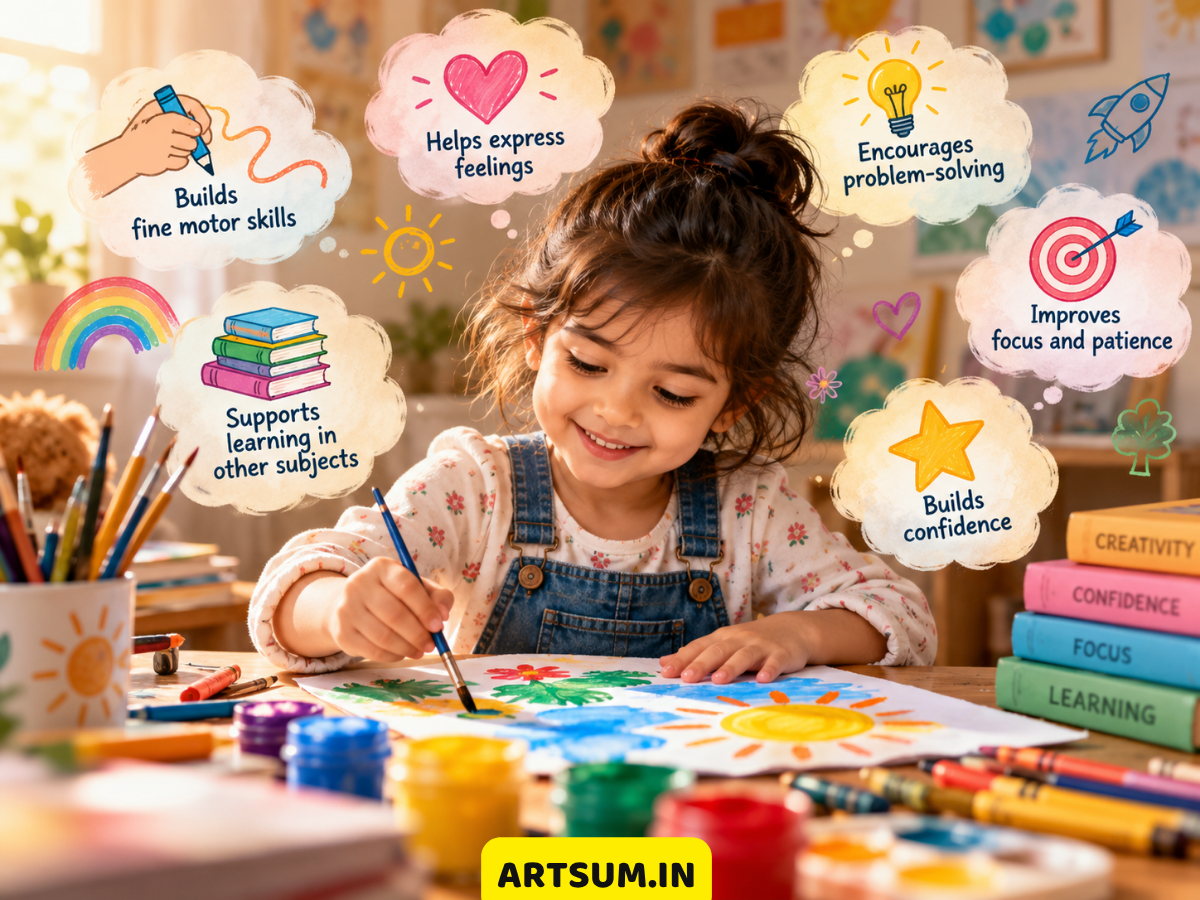
When a child picks up a crayon, it can look like simple play. But quite a lot is happening on that piece of paper.
Children use art to explore, experiment, express themselves and understand the world around them. Drawing, painting, colouring and other creative activities can support different parts of a child's development.
So, is art important for a child's development? Absolutely.
1. Art Helps Develop Fine Motor Skills
Holding a crayon, controlling a paintbrush or cutting along a line involves small movements of the hands and fingers. These activities help children develop coordination and control — skills they later use for writing, dressing themselves and handling everyday objects.
Even those first messy scribbles are part of the learning process.
2. Art Gives Children a Way to Express Feelings
Children don't always have the words to explain how they feel. Sometimes, a drawing can say something they cannot.
A child might draw something colourful and happy, or something completely unexpected. Instead of worrying about what the picture means, parents can simply ask, “Tell me about your drawing.” It can be a lovely way to start a conversation.
3. Art Encourages Problem-Solving
What colour should I use? How do I draw this? What happens if I mix these two colours?
Art gives children countless little problems to solve. Since there isn't always one correct answer, children learn to experiment, make choices and try again when something doesn't work.
4. Art Can Build Focus and Patience
A child who spends time completing a drawing is learning to stay with an activity. Finishing something they started can also give them a sense of achievement.
It may look like a simple painting, but the child is also practising patience.
5. Art Builds Confidence
There is something special about the way children proudly hold up their finished artwork.
When parents display it, appreciate it or ask about it, children begin to understand that their ideas are worth sharing. That small moment of pride can encourage them to keep creating.
6. Art Connects With Other Learning
Art doesn't exist separately from other subjects. Children explore shapes, patterns, colours, stories, nature and even numbers through creative activities.
India's National Education Policy (NEP) 2020 also encourages arts-integrated learning, recognising the value of connecting different areas of learning.
Give Children Space to Create
You don't need expensive supplies or complicated activities. Sometimes, a few crayons, some paper and the freedom to create are enough.
And when your child creates something they're proud of, don't let it disappear in a drawer.
Artsum.in gives children aged 3–18 a space to showcase their Art & Performing Arts creations FREE.
Because sometimes, a child's little drawing is doing much more than simply filling a page.
